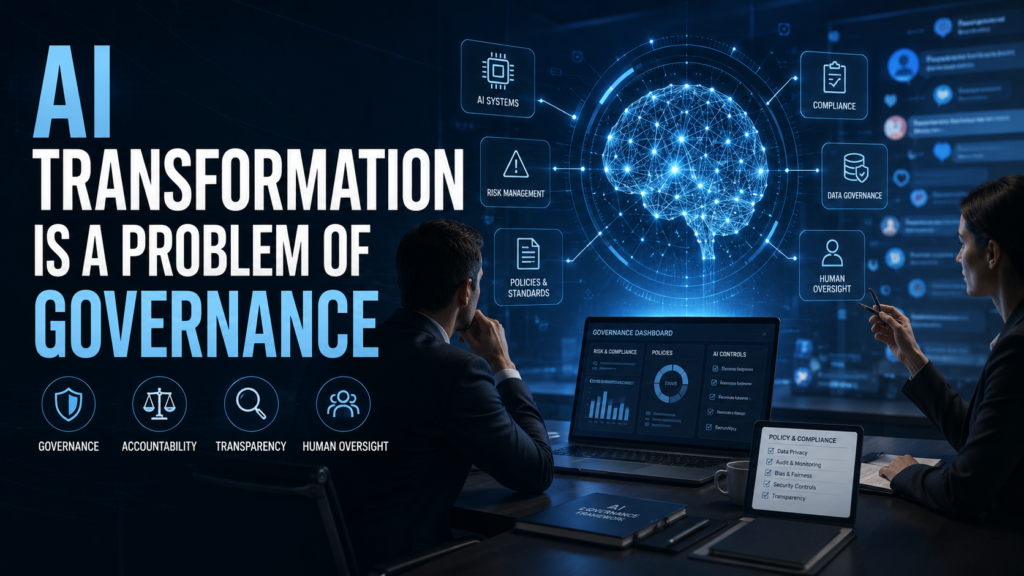
The phrase “AI transformation is a problem of governance Twitter” has emerged as a frequent search query as business leaders, developers, and consultants debate why so many enterprise artificial intelligence initiatives stall. Organizations are increasingly discovering that deploying AI successfully is rarely blocked by technical limitations; instead, projects fail because companies lack clear rules for accountability, data access, and oversight. When AI pilots move toward production, the bottlenecks shift from model performance to legal compliance, risk assessment, and decision-making authority. This article investigates the context of this circulating idea, breaking down why effective AI adoption requires robust governance frameworks rather than just better technology.
What Does “AI Transformation Is a Problem of Governance” Mean?
The core premise is that building or buying an AI model is straightforward, but safely integrating it into a business requires solving complex organizational challenges. When an organization deploys AI systems without clear rules for who decides, who is accountable, who monitors, and who acts when something goes wrong, the structural oversight fails even if the technology works.
Governance dictates how a company manages risk, ensures data quality, and maintains ethical standards. If an AI tool suggests a hiring decision, approves a loan, or writes customer-facing code, the organization must know who approved the tool’s use, what data trained it, and who holds responsibility if the output is biased or incorrect. Without these governance structures, companies accumulate “governance debt,” which manifests as legal exposure and reputational damage that becomes incredibly expensive to unravel later.
AI Transformation Is a Problem of Governance Twitter Context
Searching for the exact origin of this phrase on X (formerly Twitter) reveals that it is not tied to a single viral tweet by one specific executive, but rather represents a circulating rallying cry among CTOs, AI ethicists, and tech consultants. Users on the platform frequently share stories of dazzling AI demos that quietly get shut down months later because compliance, legal, or IT departments cannot agree on ownership or risk management.
The phrase captures a widespread frustration within the tech community: stalled AI projects are often blamed on “bad AI” when the true culprit is internal process failure. Practitioners on X highlight that as companies push past experimentation, they hit organizational walls where nobody knows who authorized a tool or how to audit its decisions. This decentralized discussion has elevated the idea into a standard lens through which businesses view AI deployment in 2026.
Why AI Transformation Creates a Governance Challenge
Implementing AI fundamentally reshapes organizational power and decision-making structures. Data teams suddenly gain strategic influence because their models drive executive actions, and if governance does not deliberately manage this shift, authority drifts to wherever the model output lands without corresponding accountability.
Several structural forces compound this challenge:
- Scale and Autonomy: A flawed human process might affect a few dozen decisions, but a flawed AI model can impact millions before the error is detected.
- Shadow AI Proliferation: Employees trying to boost productivity often adopt generative AI tools independently, feeding sensitive company data into unvetted external systems. This shadow AI thrives when official approval processes are too slow or restrictive.
- The Agentic Era: AI is no longer just generating text for human review; agentic AI systems are increasingly taking autonomous actions, such as placing orders or triggering workflows. This requires action-authorization before the fact, rather than just output-checking afterward.
AI Governance vs. AI Technology
Understanding the distinction between technology, management, and governance is essential for enterprise AI adoption.
- AI Technology: The infrastructure, models, and data science required to build and run the system.
- AI Management: The day-to-day operation ensuring the system functions efficiently and meets immediate performance metrics.
- AI Governance: The overarching framework of rules, structures, and responsibilities that clarifies who is empowered to act, who monitors the system, and who is accountable for its consequences.
Traditional IT governance focused on data protection, system uptime, and static cybersecurity audits. AI systems, however, learn and evolve; a model deployed today is not the same model six months later if it continuously ingests new data. Therefore, AI governance requires continuous monitoring, dynamic risk management, and the ability to address emergent behaviors that were not explicitly programmed.
Why Accountability Matters in AI Transformation
A primary gap in stalled AI transformations is the lack of clear ownership. Organizations frequently appoint AI leads without granting them enterprise-wide authority, resulting in fragmented strategies and duplicated efforts.
When a model’s accuracy drops or its outputs begin reflecting outdated conditions—a phenomenon known as model drift—someone must own the responsibility to intervene. Without predefined performance thresholds, retraining schedules, and escalation protocols, models drift silently. Accountability ensures that when anomalies arise, a clear escalation chain dictates who must act and how quickly, preventing a manageable incident from escalating into a public failure.
Data Governance and AI Transformation
AI models are inextricably linked to the data they consume. Inconsistent data standards across different business units result in models trained on a flawed base, producing unreliable outputs that are difficult to explain to regulators.
Effective data governance for AI encompasses:
- Data Lineage: Tracing the origin and transformation of data used to train models.
- Access Controls: Ensuring only authorized personnel and systems can interact with sensitive datasets.
- Privacy and Security: Preventing the leakage of proprietary or customer data into public models, a major driver behind corporate bans on certain AI applications.
AI Risk Management
Governing AI involves managing a spectrum of risks beyond traditional cybersecurity. Organizations must account for model risk (hallucinations, bias, drift), operational risk (system downtime impacting business continuity), and compliance risk (violating data privacy laws).
Because large language models and agentic systems can produce unpredictable outputs, risk management must anticipate uncertainty and build containment by design. This includes setting up automated alerts and dashboards for real-time visibility, rather than relying on retrospective reporting or annual audits.
Human Oversight in AI Transformation
Even as models become more autonomous, appropriate human review structures remain necessary. The level of oversight should scale with the risk profile of the application; a grammar-check tool requires far less scrutiny than an AI system determining loan eligibility or hiring outcomes.
Human oversight involves logging AI-generated decisions and human overrides to maintain an audit trail. If an employee feels unsafe admitting an AI output was wrong or lacks the room to push back against over-automation, the governance framework is failing on a cultural level.
AI Regulation and Governance
Regulatory maturity is forcing companies to treat AI governance as an operational necessity rather than a theoretical best practice. Frameworks like the EU AI Act and similar regulations emerging globally impose strict documentation, risk assessment, and ongoing monitoring obligations on high-risk AI systems.
Treating compliance as an afterthought carries substantial financial consequences. Companies are increasingly required to provide explainability for algorithmic decisions and prove they have mechanisms in place to detect and mitigate bias.
What Organizations Need for Responsible AI Transformation
To fix governance before it becomes a crisis, organizations should adopt practical frameworks:
- Name a Specific Owner: Assign a single person or committee with real authority over AI governance outcomes for every use case; shared ownership usually means no ownership when failures occur.
- Inventory Existing Tools: Audit all AI tools currently in use across the enterprise to uncover shadow AI; you cannot govern what you have not counted.
- Classify Use Cases by Risk: Implement lightweight approval processes for low-risk tools to reduce friction and prevent employees from seeking unauthorized workarounds, while applying rigorous oversight to high-risk applications.
- Enforce Ethical Principles: Translate corporate AI ethics commitments into operational metrics with attached consequences.
Why Technology Alone Cannot Solve AI Governance
Companies love investing in infrastructure, GPUs, and model fine-tuning because it feels like tangible progress, whereas writing and enforcing governance policies feels administrative. However, technology is rarely the bottleneck once a tool is viable for a pilot program. The true friction appears in ownership, oversight, and accountability when attempting to scale. Treating AI transformation as a purely technical challenge ensures that pilots will continue to die quietly after the demo phase, constrained by the very organizational structures they were meant to bypass.
Frequently Asked Questions
What does “AI transformation is a problem of governance” mean?
It means that failures in scaling enterprise AI are rarely due to poor technology. Instead, they occur because organizations lack the structures to define who decides how AI is used, who monitors its performance, and who is accountable when things go wrong.
Why is AI transformation a governance issue?
Deploying AI at scale introduces new risks, such as model drift, bias, and data leakage. Managing these risks requires clear policies, ownership, and escalation protocols, which are fundamentally organizational governance challenges rather than engineering problems.
Why is this phrase trending on Twitter/X?
Tech professionals on X frequently use this phrase to express frustration over AI pilots that stall. It serves as a diagnosis for the gap between successful technical demos and the reality of navigating internal compliance and legal roadblocks.
What is the difference between AI governance and traditional IT governance?
Traditional IT governance focuses on static system uptime and data security. AI governance must address continuous model evolution, unpredictable emergent behaviors, bias, explainability, and real-time decision-making risks.
How does shadow AI relate to governance?
Shadow AI occurs when employees use unsanctioned AI tools to do their jobs. It is usually a symptom of governance failure—specifically, when official approval processes are too slow, driving users to adopt unmonitored external systems.
What is the role of human oversight in AI?
Human oversight ensures that AI decisions can be audited, challenged, and overridden. It is critical for high-risk applications, ensuring that automated outputs align with ethical standards and business objectives.
How does data governance affect AI transformation?
AI models rely entirely on the data they ingest. Poor data governance leads to models trained on inconsistent or insecure data, resulting in unreliable outputs, privacy violations, and regulatory compliance failures.
What are the biggest risks of unmanaged AI transformation?
Key risks include making automated decisions based on biased or drifted models, leaking sensitive corporate data to public AI systems, and accumulating governance debt that leads to legal or reputational damage.
How can companies govern AI responsibly?
Companies should audit existing AI usage, name specific owners for AI use cases, classify tools by risk level, build lightweight approval processes, and establish continuous monitoring for deployed models.
What is the connection between AI governance and regulation?
Emerging regulations like the EU AI Act require companies to document, monitor, and assess the risks of their AI systems. Effective internal AI governance is necessary to prove compliance with these external legal mandates.
Moving beyond the hype of new models requires organizations to do the unglamorous work of establishing rules, boundaries, and accountability. Technology enables transformation, but governance dictates whether that transformation creates sustainable value or just new categories of unmanaged risk.
Sources / Further Reading
- TAK Devs. “AI Transformation Is a Problem of Governance in 2026.”
- Vaulten Media. “AI Transformation Is a Problem of Governance Twitter Guide 2026.”
- Multi Academia. “Why Is AI Transformation a Problem of Governance?”
- AI Insights News. “AI Transformation Is a Governance Problem (Not Tech) — 2026 Truth.”
- NeuralTrust. “AI Transformation Is a Problem of Governance.”


