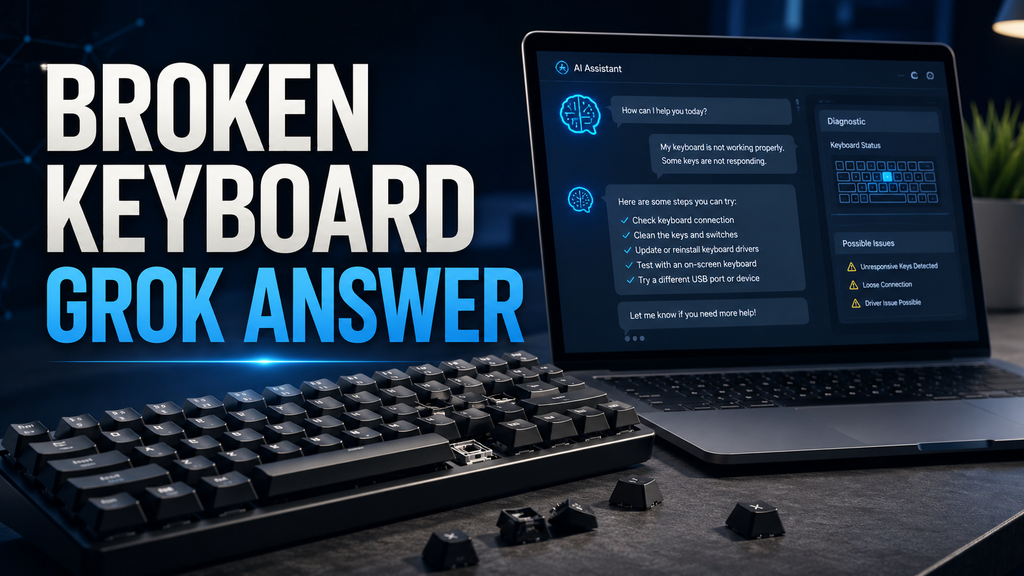
If you are searching for a broken keyboard grok answer, you are likely dealing with unresponsive keys and wondering how an AI assistant can help you fix the problem. In recent months, technology users have increasingly turned to AI models like xAI’s Grok to diagnose hardware malfunctions, seeking immediate, conversational troubleshooting steps rather than digging through traditional tech support forums.
When a peripheral stops working, it halts productivity instantly. However, figuring out whether the issue stems from a faulty USB port, an outdated driver, a software glitch, or a physical hardware failure can be frustrating. A comprehensive “broken keyboard grok answer” provides the exact diagnostic framework an AI would suggest, combined with proven, real-world technical solutions.
This guide will walk you through exactly how to troubleshoot your device, what information to feed an AI assistant for the best results, and how to determine if your keyboard can be saved or needs replacing.
What Does a “Broken Keyboard Grok Answer” Mean?
The search phrase broken keyboard grok answer refers to the specific troubleshooting advice, diagnostic steps, and technical solutions provided by Grok (or similar AI assistants) when asked how to fix a malfunctioning keyboard.
Users search for this because AI tools excel at synthesizing complex technical documentation into simple, step-by-step instructions. Instead of reading a 20-page manual, users want a direct “Grok answer” that tells them exactly what to click, check, or clean based on their specific symptoms.
However, because AI cannot physically see or touch your device, its answer is only as good as the information you provide. Understanding how to interact with the AI—and knowing the standard troubleshooting hierarchy it uses—is the key to getting your keyboard working again.
How Grok Can Help With a Broken Keyboard
While an AI assistant cannot physically solder a broken circuit board or clean out a crumb-filled mechanical switch, it serves as an excellent interactive diagnostic tool. Here is how Grok can help you navigate keyboard problems:
- Symptom Analysis: By describing exactly what your keyboard is doing (e.g., “typing multiple letters at once” or “flashing lights but no input”), the AI can narrow down the likely causes.
- Operating System Specifics: Grok can provide exact terminal commands for Linux, precise registry checks for Windows, or specific System Settings navigation for macOS.
- Driver Navigation: It can walk you through the process of uninstalling, reinstalling, or rolling back keyboard drivers step-by-step.
- Alternative Solutions: If your keyboard is entirely dead, an AI can immediately guide you on how to activate the on-screen virtual keyboard so you can continue working while you find a hardware solution.
Note: AI suggestions are guidance based on aggregated data. They cannot identify physical hardware faults with absolute certainty.
What Information Should You Give Grok?
To get the most accurate AI troubleshooting advice, you need to write a highly specific prompt. If you simply type, “My keyboard is broken,” the AI will return a generic list of fixes. To get a precise, tailored response, provide the following details:
- Device Type: Are you using a laptop keyboard or an external desktop keyboard?
- Connection Method: Is it wired (USB), wireless (2.4GHz dongle), or Bluetooth?
- Operating System: Are you on Windows 10, Windows 11, macOS, Linux, or ChromeOS?
- Exact Symptoms: Do no keys work? Do only specific keys fail? Is there a delay when typing?
- Recent Events: Did you recently update your operating system, spill a drink, or drop the device?
- Troubleshooting Already Attempted: Tell the AI what you have already tried (e.g., “I already restarted my computer and tried a different USB port”).
Example of a great prompt: “I have a mechanical USB keyboard plugged into a Windows 11 PC. The WASD keys stopped working suddenly after a Windows update, but the RGB lights are still on. I have already tried plugging it into a different USB port. What steps should I take to fix this?”
Common Signs of a Broken Keyboard
Before diving into fixes, it is important to identify your exact symptom, as this dictates the solution. Common keyboard problems include:
- Complete Unresponsiveness: No keystrokes register, and no indicator lights turn on.
- Specific Keys Not Working: A cluster of keys (like the number pad or a specific row) fails, while others work perfectly.
- Repeated Characters (Chatter): Pressing a key once results in multiple characters appearing on screen (e.g., typing “hello” outputs “hellllo”).
- Delayed Input: You press a key, but the character takes several seconds to appear.
- Random Characters: Pressing one key outputs an entirely different letter or symbol.
- Liquid Damage Symptoms: Sticky keys or erratic behavior immediately following a spill.
How to Troubleshoot a Broken Keyboard
Whether you are consulting an AI or fixing it yourself, the troubleshooting process should always move from the simplest, most common fixes to more complex interventions. Follow these step-by-step instructions.
1. Check the Physical Connection
The most common cause of a keyboard not working is a loose connection.
- Wired Keyboards: Unplug the USB cable and plug it into a different port. Prefer ports directly on the motherboard (the back of a desktop PC) rather than front-panel hubs.
- Wireless Keyboards: Ensure the USB receiver is fully inserted. Try moving it to a port closer to the keyboard to reduce interference.
- Bluetooth Keyboards: Turn the keyboard off and on. Unpair it from your computer’s Bluetooth settings and re-pair it.
2. Check the Power Source
If the keyboard relies on internal power, a dead battery will cause sudden failure.
- Replace standard AA or AAA batteries.
- If the keyboard has an internal rechargeable battery, plug it into a wall charger for at least 15 minutes before testing again.
3. Restart Your Device
A simple system reboot clears temporary software glitches, resets background processes, and forces the operating system to re-poll connected USB devices. Always restart your computer before making drastic changes to drivers or settings.
4. Test on Another Computer
This is the ultimate diagnostic test. Plug your keyboard into a different laptop or desktop.
- If the keyboard works on the second device, your problem is software-related on the first computer.
- If the keyboard does not work on the second device, the keyboard has a physical hardware failure and likely needs replacement.
5. Check and Reinstall Drivers (Windows)
Corrupted drivers frequently cause keyboard failure.
- Right-click the Start button and select Device Manager.
- Expand the Keyboards section.
- Right-click your keyboard and select Uninstall device.
- Restart your computer. Windows will automatically reinstall a fresh driver upon reboot.
6. Clean the Keyboard
If specific keys are sticky or unresponsive, physical debris may be blocking the switch mechanism. Use compressed air to blow out dust and crumbs. For mechanical keyboards, use a keycap puller to remove the plastic caps and clean the switches with isopropyl alcohol and a cotton swab.
Broken Keyboard Hardware vs. Software Problems
Distinguishing between a physical failure and a digital glitch is crucial. Use this table to narrow down your issue:
| Symptom / Indicator | Likely Cause | Suggested Action |
|---|---|---|
| Keyboard works in BIOS but not in OS | Software / Driver Issue | Boot into Safe Mode, reinstall drivers. |
| Spill occurred recently, keys are sticky | Hardware Issue | Power off immediately, clean, let dry for 48 hours. |
| A single row or diagonal line of keys failed | Hardware Issue (Circuit Matrix) | Usually requires keyboard replacement. |
| Extreme typing lag or delayed input | Software Issue / Interference | Close background apps; move wireless receivers closer. |
| Device Manager shows a yellow triangle | Driver Issue | Update or roll back the specific keyboard driver. |
| Cord is frayed or bent at a sharp angle | Hardware Issue (Cable) | Cable replacement (if possible) or replace keyboard. |
Can Grok Actually Diagnose a Broken Keyboard?
A common question is whether an AI can accurately diagnose hardware problems. The answer is nuanced.
Grok and other AI models are highly proficient at logical deduction based on user input. If you describe the symptoms accurately, the AI can cross-reference millions of troubleshooting guides in seconds to give you the most statistically probable cause. It can quickly tell you if your issue sounds like a Windows Registry error or a failing mechanical switch.
However, AI has severe limitations regarding physical hardware. It cannot:
- Inspect a circuit board for water corrosion.
- Test a USB port for electrical output.
- Verify if a ribbon cable inside a laptop has come loose.
- Hear if a mechanical switch has lost its tactile click.
Therefore, you should view AI as a highly intelligent manual that guides your hands, not an omniscient technician that can magically cure a hardware defect.
When Should You Replace a Broken Keyboard?
While many software and driver issues are easily fixed, physical damage often warrants a replacement. You should consider buying a new keyboard if:
- Liquid Damage was Severe: Sugary drinks or coffee can corroide the internal membrane over time, even if the keyboard temporarily works after drying.
- The Matrix is Broken: If an entire vertical or horizontal line of keys fails, the internal circuit matrix is likely cracked. This is generally unrepairable for standard membrane keyboards.
- Laptop Keyboard Issues: If a laptop keyboard fails (and it is not software), replacing it requires opening the chassis. Depending on the laptop model, paying a professional for this repair may be more expensive than simply buying an external USB keyboard.
- It Fails the Multi-Device Test: If the keyboard does not work on any computer you plug it into, the internal controller board has likely died.
Frequently Asked Questions
What does broken keyboard mean? A broken keyboard refers to a peripheral that fails to register keystrokes properly. This can range from a single unresponsive key to complete device failure, and it can be caused by physical damage, connectivity issues, or software glitches.
Can Grok help fix a broken keyboard? Yes. Grok can provide step-by-step troubleshooting instructions, help you identify whether the issue is hardware or software, and guide you through operating system settings to reinstall drivers or adjust input configurations.
What should I ask Grok about a broken keyboard? To get the best answer, provide your operating system, whether the keyboard is wired or wireless, the exact symptoms (e.g., repeating keys, totally dead), and what steps you have already tried to fix it.
Why is my keyboard not working? The most common reasons are loose USB/wireless connections, dead batteries, corrupted device drivers, operating system updates causing conflicts, or physical debris trapped under the keys.
How can I tell if my keyboard is physically damaged? The best way to check for physical damage is to plug the keyboard into a completely different computer. If it still does not work on a new device, the hardware itself is faulty.
Can a keyboard driver cause keys to stop working? Yes. If a driver becomes corrupted or conflicts with a recent operating system update, it can prevent the computer from translating the keyboard’s physical inputs into digital signals.
Why do some keyboard keys work while others do not? This is often caused by debris blocking the physical switch beneath the keycap. It can also be caused by damage to the internal circuit matrix, where a specific pathway has been broken by impact or liquid.
Can I test a keyboard on another computer? Yes, this is highly recommended. Testing your keyboard on a different desktop or laptop is the fastest way to determine if the problem is in the keyboard itself (hardware) or in your computer (software).
Should I repair or replace a broken keyboard? If it is an expensive mechanical keyboard, replacing individual switches or cables is often worth it. If it is a basic, inexpensive membrane keyboard, replacement is usually more cost-effective and reliable than attempting a repair.
Can AI accurately diagnose hardware problems? AI can suggest highly probable causes based on the symptoms you describe, but it cannot accurately verify hardware problems because it cannot physically inspect the device. It relies entirely on the accuracy of your descriptions.
Conclusion
Finding a definitive broken keyboard grok answer means combining the rapid analytical power of AI with practical, hands-on troubleshooting. Whether your keys are lagging, repeating, or completely unresponsive, starting with the simplest solutions—like checking connections and restarting your device—will resolve the majority of issues.
By understanding how to clearly explain your symptoms to an AI assistant, you can quickly determine if you are dealing with a simple driver error or a physical hardware failure. If software tweaks and thorough cleaning do not restore your device, and it fails to work on a secondary computer, it is likely time to invest in a replacement.
Sources / Further Reading
- Microsoft Support: Troubleshoot problems with your Microsoft mouse or keyboard.
- Apple Support: If your Mac doesn’t respond to key presses.
- xAI Documentation: Best practices for prompting Grok for technical support and diagnostic assistance. (Note: Specific hardware diagnosis relies on standard IT troubleshooting frameworks).


