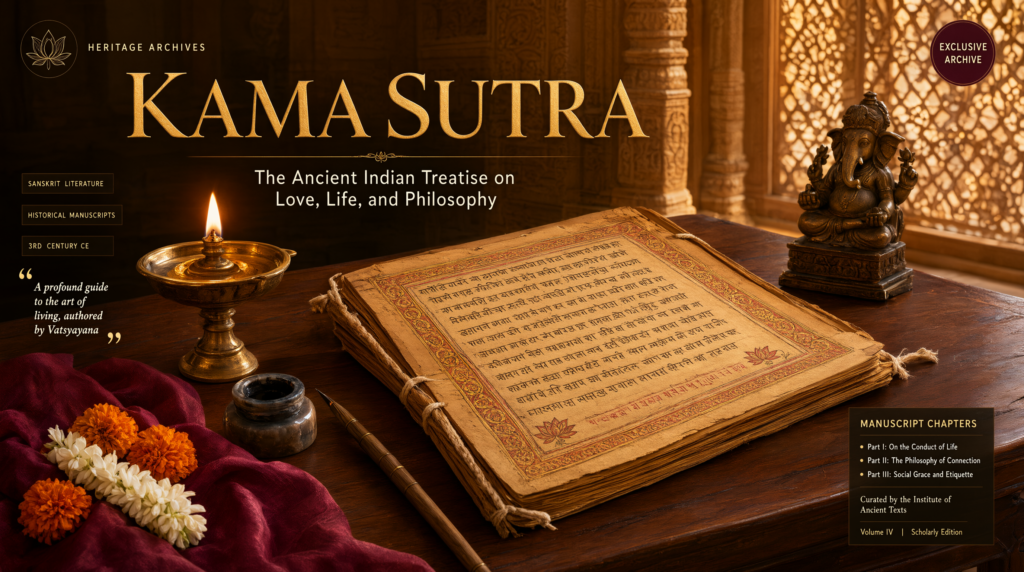
The Kama Sutra is one of the most famous works of ancient Indian literature—and also one of the most misunderstood. Many people recognize the name, but far fewer know what the book actually contains. In popular culture, the phrase “Kama Sutra” is often treated as shorthand for a catalog of sexual positions. In reality, the Kama Sutra is a wide-ranging Sanskrit text about love, desire, courtship, marriage, social life, and the pursuit of pleasure within an ethical framework.
This article explains the Kama Sutra meaning, its historical origins, who wrote it, what the text actually teaches, and why it remains culturally significant today.
What Is Kama Sutra?
The Kama Sutra is an ancient Indian guide to love, pleasure, and refined living. It is written in Sanskrit and attributed to the scholar Vātsyāyana, often written in English as Vatsyayana. The work belongs to a larger tradition of Sanskrit texts called Kama Shastra, or “the science of desire.”
Unlike the modern stereotype, the Kama Sutra book is not only about sex. It discusses:
- The meaning and purpose of love
- Courtship and choosing a partner
- Marriage and household responsibilities
- Social etiquette and personal refinement
- The role of pleasure in a good life
- The arts and skills of a cultured person
The text is serious, philosophical, and practical. It treats desire—kama—as a legitimate human goal when pursued responsibly and in harmony with duty and virtue.
What Does “Kama Sutra” Mean?
The Kama Sutra meaning comes from two Sanskrit words:
- Kama – desire, pleasure, love, sensual enjoyment, or aesthetic delight
- Sutra – a thread, rule, or concise aphorism
Together, the title can be understood as “aphorisms on desire” or “a treatise on love and pleasure.”
In Indian philosophy, kama is one of the four major aims of human life, known as the purusharthas:
- Dharma – duty, morality, righteousness
- Artha – wealth, power, material success
- Kama – desire, pleasure, love
- Moksha – spiritual liberation
The Kama Sutra does not treat kama as shameful or trivial. Instead, it argues that pleasure is an important part of a well-lived life—provided it is pursued with knowledge, self-control, and respect for social and ethical responsibilities.
The word sutra also signals the text’s style. Like many ancient Indian texts, it is written in compact, memorable statements that were likely meant to be expanded upon by a teacher.
Who Wrote the Kama Sutra?
The Kama Sutra author is traditionally identified as Vātsyāyana Mallanāga, often simply called Vatsyayana. However, very little is known about his life.
What scholars can say with reasonable confidence is that Vatsyayana presents himself as a compiler and systematizer rather than an entirely original inventor. He drew on earlier teachers and earlier works in the Kama Shastra tradition.
Key points about the authorship:
- The text is traditionally attributed to Vatsyayana.
- Some manuscripts give the fuller name Vātsyāyana Mallanāga, but biographical details are not independently confirmed.
- Vatsyayana himself says he studied earlier authorities and summarized their teachings.
- There is no reliable historical record of his birthplace, family, occupation, or exact dates.
It is important to distinguish historical evidence from later popular claims. The idea that the book was written by a celibate sage, a court scholar, or a religious figure is not supported by solid historical documentation.
When Was the Kama Sutra Written?
The exact date of the Kama Sutra is uncertain. Ancient Indian texts often do not carry fixed dates, and dating usually depends on language, style, references to other works, and manuscript traditions.
Most modern scholars place the Kama Sutra between the 2nd and 4th centuries CE. A commonly cited estimate is around the 3rd century CE, but this remains a scholarly approximation rather than an established fact.
Because the text summarizes earlier authorities, some of its ideas and traditions are clearly older than the text itself. The Kama Sutra origin, therefore, lies in a long intellectual and literary tradition rather than a single moment of composition.
The History and Origins of Kama Sutra
The Kama Sutra history is connected to the broader development of ancient Indian literature and philosophy. By the early centuries of the Common Era, Indian thinkers had produced detailed treatises on dharma (duty), artha (wealth), and kama (pleasure). The Kama Sutra was intended to be the kama counterpart to works on the other aims of life.
The text is part of the Kama Shastra tradition, a body of Sanskrit literature devoted to love, desire, and erotic knowledge. Vatsyayana explicitly acknowledges earlier writers, though many of their works have not survived.
The Kama Sutra was not a sudden or scandalous invention. It was a scholarly synthesis of existing ideas, written for an educated urban audience. It fits into a wider ancient Indian culture that valued systematic knowledge about every aspect of human life.
The Kama Sutra remained known in India for centuries, but it became famous in the West only after an English translation appeared in 1883. That translation is often associated with the British explorer and writer Sir Richard Francis Burton, though the translation work was likely collaborative and is debated by scholars.
What Is the Kama Sutra About?
The Kama Sutra is best understood as a guide to love, pleasure, and social refinement. It covers far more than sexual activity.
The text discusses:
- The place of pleasure in a balanced life
- How to cultivate personal charm and refinement
- The arts and skills of a cultured person
- Courtship, love, and selecting a partner
- Marriage and household management
- Social conduct and relationships
- The lives and roles of courtesans
- Attraction and emotional connection
One of the central ideas of the Kama Sutra is that pleasure should not be left to chance. Like any important human pursuit, it requires knowledge, preparation, and an understanding of human nature.
The text also emphasizes consent, mutual respect, and the emotional dimension of intimacy. While some sections are explicit by modern standards, the overall tone is educational and philosophical rather than sensational.
The Structure of the Kama Sutra
The Kama Sutra book is organized into seven parts and thirty-six chapters. This structure helps readers see that sexual positions form only one part of a much larger work.
The seven major sections are:
- General Principles
An introduction to the aims of life, the nature of kama, and the importance of pleasure. - On Sexual Union
A detailed discussion of intimacy, attraction, and different forms of sexual union. This is the section most often excerpted in popular culture, but it is only one part of the book. - On Acquiring a Wife
Courtship, choosing a partner, forms of marriage, and how to build a relationship. - On the Duties of a Wife
Household life, the responsibilities of a married woman, and managing a home. - On Other Men’s Wives
A cautious discussion of attraction outside marriage, including ethical warnings and social risks. - On Courtesans
The lives, skills, and economic independence of courtesans in ancient Indian society. - On Erotic Esoterica
Attraction, personal charm, and traditional practices for enhancing appeal. This section includes material that reflects folk traditions and cultural beliefs of the time.
Kama Sutra and Ancient Indian Culture
The Kama Sutra is an important source for understanding ancient Indian culture, particularly urban life among the educated and wealthy classes.
It reveals a society that valued:
- Education and refinement
- The arts, music, and poetry
- Manners and social grace
- The importance of marriage and household life
- A sophisticated understanding of human relationships
At the same time, the text does not represent all of ancient India. It was written for an elite, largely urban readership. Its social norms—especially around gender, class, and marriage—reflect its historical context and should not be read as timeless or universal.
The Kama Sutra is also part of a larger cultural interest in pleasure and beauty. Ancient Indian temple sculpture, poetry, and painting often explore erotic and romantic themes. The Kama Sutra is one literary expression of that broader tradition.
Common Misconceptions About Kama Sutra
The Kama Sutra is widely misunderstood. Here are some of the most common misconceptions:
- Myth: The Kama Sutra is only a manual of sexual positions.
Reality: Sexual positions are discussed in only one of the book’s seven parts. The work covers love, courtship, marriage, social life, and personal refinement. - Myth: The Kama Sutra is a religious text.
Reality: It is not a religious scripture. It is a secular treatise on pleasure and social conduct, though it draws on the broader worldview of Indian philosophy. - Myth: The Kama Sutra is pornographic.
Reality: It is explicit in some sections, but its purpose is educational and philosophical. It treats desire as a serious subject of study. - Myth: The Kama Sutra was written for everyone.
Reality: It was primarily intended for urban, educated elites, not for all members of ancient Indian society. - Myth: The Kama Sutra is a single original work.
Reality: It is a synthesis of earlier Kama Shastra traditions, compiled and systematized by Vatsyayana.
Is the Kama Sutra Still Relevant Today?
The Kama Sutra remains relevant today for historical, literary, and cultural reasons.
As a work of ancient Indian literature, it offers insight into how educated people in early India thought about love, marriage, pleasure, and social life. It is a valuable primary source for historians studying gender, family, urban culture, and sexuality.
The text also challenges modern readers to think more broadly about pleasure. It presents desire not as something shameful, but as a meaningful part of human experience that deserves understanding and careful attention.
That said, the Kama Sutra is not a modern relationship manual. Some of its social assumptions—especially around gender and class—belong to another time. Modern readers should approach it with historical awareness rather than expecting direct advice for contemporary life.
Frequently Asked Questions About Kama Sutra
What is Kama Sutra?
The Kama Sutra is an ancient Indian Sanskrit text on love, desire, courtship, marriage, social conduct, and pleasure. It is traditionally attributed to Vatsyayana.
Who wrote Kama Sutra?
The Kama Sutra is traditionally attributed to Vatsyayana, also called Vātsyāyana Mallanāga. Little is known about his life, and he likely compiled earlier traditions.
When was Kama Sutra written?
Most scholars date the Kama Sutra to between the 2nd and 4th centuries CE, with the 3rd century CE as a common estimate. The exact date is uncertain.
What does Kama Sutra mean?
The term combines kama (desire, pleasure, love) and sutra (thread, rule, aphorism). It can be translated as “aphorisms on desire” or “a treatise on love and pleasure.”
Is Kama Sutra a religious book?
No. The Kama Sutra is not a religious scripture. It is a secular treatise on pleasure and social life, written within the broader framework of Indian philosophy.
What language was Kama Sutra originally written in?
The Kama Sutra was originally written in Sanskrit, the classical literary language of ancient India.
What is the historical importance of Kama Sutra?
The Kama Sutra is historically important because it provides a detailed view of ancient Indian ideas about love, marriage, social conduct, and pleasure. It is a key text in the history of ancient Indian literature and culture.
Conclusion
The Kama Sutra is far more than its modern reputation suggests. It is a sophisticated ancient Indian Sanskrit text that explores love, desire, courtship, marriage, and social refinement. Attributed to Vatsyayana, the work belongs to a long tradition of Indian philosophical and literary writing about the good life.
Understanding the true Kama Sutra meaning and history helps readers move beyond clichés and appreciate the text as a serious work of cultural and intellectual significance. While some parts are explicit, the book’s central concern is not mere sexual technique but the broader human pursuit of pleasure, connection, and refined living.
Sources and Further Reading
- Encyclopaedia Britannica: Kama Sutra
- World History Encyclopedia: Kama Sutra
- Doniger, Wendy, and Sudhir Kakar, trans. Kamasutra. Oxford World’s Classics.


