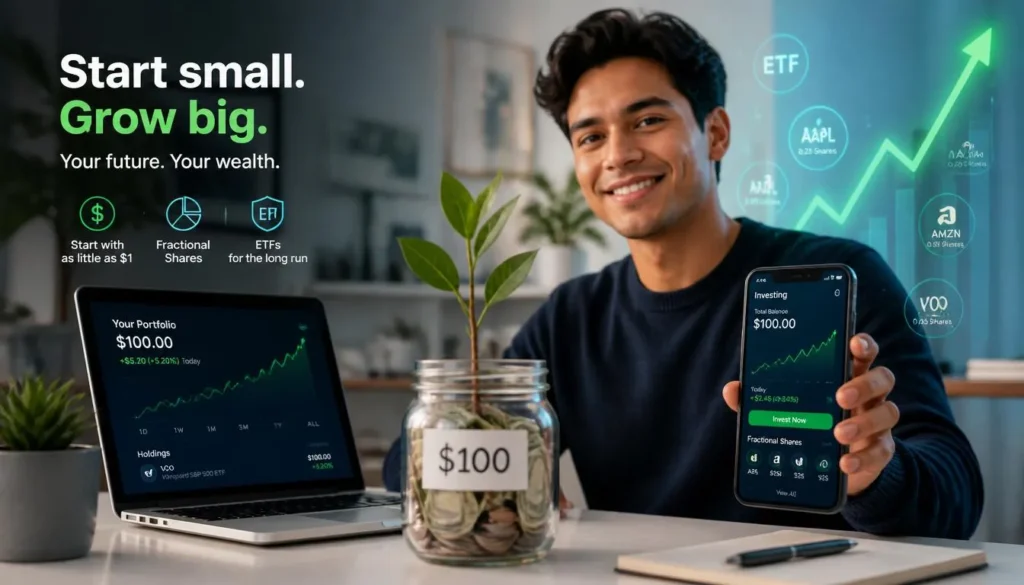
1. Is Your First $100 Enough? Debunking Myths
Many people think you need thousands of dollars to start investing. That used to be true a long time ago. But today, the answer is simple: Yes, $100 is plenty of money to start.
The world of investing has changed completely. You no longer need to be rich to play the game. Today, investing is easy, cheap, and open to everyone. Why? Because new apps and websites have taken away the old rules.
Here is what makes it so easy today:
- Zero Minimums: You can open an account with $0.
- No Trading Fees: Buying and selling usually costs nothing.
- Fractional Shares: You can buy a tiny piece of a big stock.
Brokers like Fidelity, Charles Schwab, E*TRADE, and Webull let you open an account for free. You don’t have to wait until you have a lot of money. You can start learning right now.
The Power of Good Habits
The best thing about starting with just $100 is that it teaches you good habits. The most important habit is called Dollar-Cost Averaging (DCA).
DCA simply means you invest a little bit of money on a regular schedule. For example, you decide to invest $20 every Friday.
- When the stock market is cheap, your $20 buys more pieces of a company.
- When the stock market is expensive, your $20 buys fewer pieces.
This takes away the stress. You don’t have to guess if the market is going up or down. You just keep adding a little bit of money like clockwork.
What Are Fractional Shares?
Imagine a pizza that costs $3,000. You only have $10. In the past, you couldn’t buy the pizza. Today, “fractional shares” let you buy a $10 slice of that pizza. This is amazing for beginners. It means you can own a piece of big, expensive companies with just a few dollars. It also helps you spread your money around safely, which is called diversification (not putting all your eggs in one basket).
A Safe Waiting Room for Your Money
Before you buy any stocks, where should you keep your $100? The best place is a High-Yield Savings Account (HYSA). In 2026, these bank accounts pay you about 4.10% to 4.25% in interest just for keeping your money there. It is a safe “waiting room” while you decide what to invest in.
2. Where to Put Your Money: Choosing an App

Picking the right app is very important. There are four main types of platforms in 2026. Here is the easy way to understand them:
1. Online Brokers (Like Fidelity or Schwab) These are like big supermarkets. You can buy anything you want. They are free to use, and they have great tools to teach you about money. They are best for people who want to pick their own investments.
2. Robo-Advisors (Like Betterment or Wealthfront) A “robo-advisor” is a computer program that invests your money for you. You just tell it your goals, and it does all the hard work. They usually charge a very tiny fee. This is best if you want to be completely hands-off.
3. Micro-Investing Apps (Like Acorns) These apps connect to your debit card. If you buy a coffee for $3.50, the app rounds it up to $4.00 and takes that extra $0.50 to invest it. It turns your spare change into investments without you even noticing.
4. Tax-Advantaged Accounts (Like a Roth IRA) A Roth IRA is a magic bucket for your retirement. When you put money in this bucket, the government promises not to tax your profits when you take it out when you are older. This is the best place for long-term saving.
| App Type | Minimum to Start | Who is it best for? | Do you pick the stocks? |
|---|---|---|---|
| Online Brokers | $0 | People who want to learn | Yes, you have full control |
| Robo-Advisors | $0 to $500 | People who want a computer to do it | No, it’s automatic |
| Micro-Investing | $5 | People who want to invest spare change | No, it’s automatic |
| Roth IRA | $0 | People saving for the distant future | Yes |
3. Your First Investment: Building a Starter Portfolio
Now you have an account and $100. What do you buy? You should buy an ETF.
An Exchange-Traded Fund (ETF) is like a basket of groceries. Instead of buying just one apple (like buying just Apple stock), you buy a basket that has a little bit of every fruit in the store.
If you buy a “Total Stock Market ETF,” you are buying a tiny piece of thousands of American companies all at once. If one company does badly, you are still safe because you own thousands of other companies that might be doing well.
Watch Out for Fees (Expense Ratios)
Some funds charge you a yearly fee called an “expense ratio.” You want this number to be as small as possible. If a fee is 1.00%, that is too high. You want a fee around 0.03%. That means if you invest $10,000, you only pay $3 a year in fees!
The Best Beginner ETFs
Here are three popular, very cheap baskets you can buy:
- VTI (Vanguard Total Stock Market ETF): This basket holds over 3,500 US companies. It costs almost nothing to own (0.03% fee).
- SCHB (Schwab U.S. Broad Market ETF): This holds 2,500 big American companies. Also super cheap (0.03% fee).
- BND (Vanguard Total Bond Market ETF): This is a basket of “bonds” (which are safer, slower-growing investments). It helps keep your money stable when the stock market gets crazy.
The Easiest Starter Strategy: If you only have $100, keep it simple. Put the whole $100 into one basket like VTI. Do not worry about anything else right now.
4. Step-by-Step Plan: Getting Started

Ready to go? Follow these 6 easy steps:
- Pick Your Goal: Are you saving for next year or for when you are 60 years old?
- Open an Account: If it’s for the far future, open a Roth IRA account.
- Put in Your $100: Transfer $100 from your normal bank to your new investment account.
- Make Your First Buy: Search for a basket like “VTI” and buy $100 worth of it using fractional shares.
- Put it on Auto-Pilot: Tell your bank to automatically send $25 or $50 to your investment account every time you get paid.
- Do Not Look at It: The market goes up and down. Looking at it every day will just make you nervous. Check it only once a year!
5. Avoiding Common Mistakes
Investing is easy, but humans have emotions that make it hard. Watch out for these three big mistakes:
- Mistake 1: FOMO (Fear Of Missing Out). Your friends might brag about getting rich on a crazy new crypto coin or meme stock. Do not copy them. Stick to your safe, boring basket of stocks. Boring investing makes the most money in the end.
- Mistake 2: Panic Selling. Sometimes, the stock market crashes. The value of your $100 might drop to $80. Do not get scared and sell! A crash just means stocks are on sale. Keep buying your regular amount. The market always recovers over time.
- Mistake 3: Putting All Eggs in One Basket. Do not spend your $100 on just one company (like only buying Netflix). If Netflix has a bad year, you lose. Buy an ETF so you own thousands of companies.
6. What Your $100 Can Become: The Magic of Time
Why are we doing this? Because of a magic trick called Compound Interest.
Compounding means your money goes to work and earns some money. Then, those new earnings go to work and earn even more money. It is like a snowball rolling down a snowy hill. It starts small, but as it rolls, it gets bigger and faster.
Here is the math formula that makes this happen: $$A = P(1 + r)^t$$
(Where A is your total money, P is your starting money, r is the interest rate, and t is time!)
Let’s Look at a Real Example
Imagine you invest your $100 today. After that, you decide to automatically invest just $50 every month. You do this for 20 years. We will guess the stock market grows by an average of 7% a year.
After 20 years, you would have put in $12,100 of your own money. But because of the compounding magic snowball, your account would actually be worth over $25,000! Your money made you $12,900 for free just by sitting there.
Look at how fast the snowball grows if you give it time (assuming a 7% return):
| Your Monthly Habit | After 10 Years | After 20 Years | After 30 Years |
|---|---|---|---|
| Save $25 / month | $4,626 | $21,866 | $69,085 |
| Save $50 / month | $9,253 | $43,732 | $138,170 |
| Save $100 / month | $18,505 | $87,465 | $276,340 |
Starting small is not a bad thing. It is the very first step to building a huge snowball. The best time to start is today!
7. Frequently Asked Questions (FAQ)
1. Do I really only need $100 to start? Yes! Today, many apps let you open an account for $0 and buy tiny slices of stocks for just $1 or $5. $100 is plenty to begin.
2. What is an ETF? ETF stands for Exchange-Traded Fund. Imagine a basket filled with tiny pieces of thousands of different companies. When you buy an ETF, you are buying the whole basket.
3. What is a fractional share? If a stock costs $3,000, you don’t have to buy the whole thing. A fractional share lets you buy just a small slice of it for $5 or $10.
4. Is investing in the stock market safe? In the short term (days or months), it goes up and down, so it can be risky. But over a long time (10 to 20 years), the market has historically always gone up.
5. What is a Roth IRA? It is a special type of retirement account. If you put money into it, all the profit you make over the years is completely tax-free when you take it out after age 59½.
6. How often should I check my investments? Try to check it only once or twice a year. Checking it every day will just make you nervous because prices jump around a lot.
7. What should I do if the stock market crashes? Do nothing, and do not panic sell! Keep putting your normal amount of money in. Think of a crash as the stock market throwing a “half-price sale.”
8. What is Dollar-Cost Averaging? It is just a fancy term for investing a set amount of money on a regular schedule (like $20 every single Friday), no matter what the stock market is doing.
9. Do I have to pay taxes on my profits? If you use a normal account, yes, you pay taxes when you sell. If you use a special account like a Roth IRA, your money grows tax-free.
10. Can I take my money out whenever I want? In a normal brokerage account, yes, you can sell your stocks and move the money to your bank anytime. But for a Roth IRA, there are rules, and it’s best to leave it until you are older.
11. Should I buy single stocks like Apple or Tesla? For beginners, it is much safer to buy an ETF (the big basket). Buying single stocks is risky because if that one company does badly, you lose your money.
12. What is compound interest? It is when your money earns profit, and then that profit earns even more profit. Over many years, it makes your money grow incredibly fast like a giant snowball.
Disclaimer
Financial Disclaimer & Editorial Disclosure (DYOR) Do Your Own Research (DYOR): The information provided in this article is for educational, informational, and illustrative purposes only. It does not constitute professional investment, tax, or legal advice. Financial markets are subject to high market volatility, and investing involves risks, including the possible loss of principal. Past performance is not indicative of future results. Please consult with a licensed, fee-only fiduciary financial advisor, CPA, or tax professional before making any financial decisions tailored to your unique financial situation. Our editorial team maintains strict standards of integrity; we perform independent research and verify all data points against official regulatory bodies (such as the IRS, SEC, and FINRA).
Author Bio
Josephine is a personal finance writer at FinanceWealthTools.com
with a focus on dividend investing, passive income strategies, and
retirement planning. She is dedicated to turning complex financial
topics into clear, practical guides that help everyday investors
build real, lasting wealth. Her writing combines thorough research
with straightforward advice — because good financial guidance
should never require a finance degree to understand.


