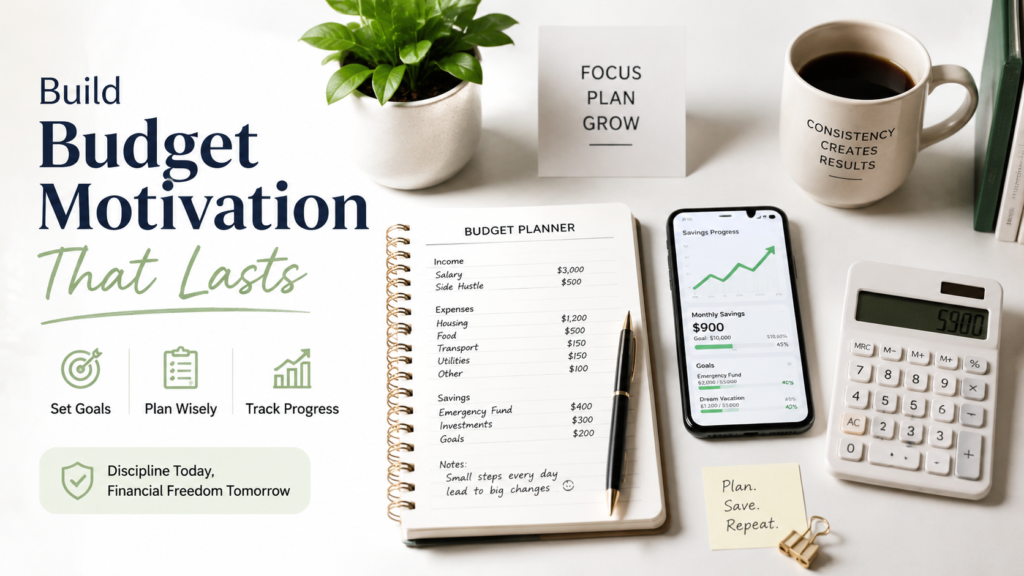
You sit down on the first of the month and build a detailed budget: rent, groceries, gas, savings, a little left over for fun. For a few days, it works. Then a coworker suggests lunch out, a forgotten subscription renews, or the car makes a noise it shouldn’t be making, and the plan starts to slip. By the second week, you’ve stopped checking it. By the end of the month, it’s like it never existed.
This pattern is common enough that it barely needs explaining, yet most budgeting advice skips right past it. Plenty of articles explain how to build a budget. Far fewer explain why sticking to one is so hard, or what to do once motivation drops off partway through the month. That gap matters, because budget motivation isn’t really about willpower. It’s about building a plan that doesn’t rely entirely on willpower to survive the month. Motivation can get a budget started, but the goal is habits sturdy enough to carry it once that first burst of motivation fades, which happens to almost everyone eventually.
What Is Budget Motivation?
Budget motivation is what keeps you engaged with a spending plan: checking it, adjusting it, and actually following through, even after the novelty of building it wears off. It isn’t one single feeling. It’s closer to a mix of factors, including how clear your financial goals are, how much progress you can actually see, and how well your day-to-day budgeting habits fit into a normal life.
A budget by itself is just numbers on a page or in an app. What turns those numbers into results is the repeated decision to follow them, like spending less on takeout this week because the plan calls for it, or moving money into savings the way it was supposed to. That repeated decision is where motivation comes in, and it’s also where most budgets quietly fall apart. The numbers usually aren’t the problem. The motivation to keep using them is.
Why Is It So Hard to Stay Motivated to Budget?
A few realistic reasons come up again and again for people who’ve tried budgeting and struggled to keep it going:
- It can feel restrictive. A plan that treats every non-essential purchase as a failure starts to feel like a strict diet, and most people don’t stick with diets that eliminate everything they enjoy.
- Results take time to show up. Moving $50 into savings doesn’t feel like much in the moment, and it’s easy to lose interest before the balance grows large enough to feel meaningful.
- Unexpected expenses show up anyway. A flat tire or a medical bill can undo weeks of careful planning in a single afternoon, which makes it tempting to abandon the whole budget once it happens.
- The first budget is often unrealistic. Cutting spending too aggressively, no takeout, no streaming, no new clothes, creates a plan that’s almost designed to fail within a few weeks.
- Tracking every purchase is tiring. Logging a $4 coffee next to a rent payment can feel like more effort than it’s worth without an easy system for doing it.
- Comparing finances with other people is discouraging. A friend’s vacation or a coworker’s new car can make a modest, working budget feel unglamorous by comparison.
- Large goals can feel distant. A goal like paying off $15,000 in debt is motivating in theory but can feel too far away to influence today’s decisions.
- A budget with no room to enjoy life is hard to sustain. When every dollar is assigned to bills and savings with nothing left over, most people eventually give it up out of plain fatigue.
10 Practical Ways to Improve Your Budget Motivation
These ideas work best when they’re actually put into practice rather than just read and nodded along to. Here’s how to apply each one:
- Start with one clear financial goal. Rather than trying to fix every part of your finances at once, choose a single target, like a $1,000 starter emergency fund or paying off one credit card. A specific goal is easier to stay motivated about than a vague intention to “do better with money.”
- Make the first budget realistic, not aspirational. Base it on how you actually spend, not how you wish you spent. If you currently spend $300 a month eating out, don’t set that number to $50 right away. Bring it down gradually so the plan is one you can actually follow.
- Track progress instead of only tracking restrictions. Keep an eye on what’s moving in the right direction, like a growing emergency fund or a shrinking debt balance, instead of focusing only on what you can’t buy.
- Create small milestones inside larger goals. If the goal is $3,000, treat $500 and $1,500 as checkpoints worth noticing, rather than waiting until the full amount to feel any sense of progress.
- Give yourself a reasonable spending category for things you enjoy. A modest, defined amount for dining out or entertainment each month is usually easier to live with than a plan that assumes you’ll spend on nothing but necessities.
- Automate savings where it makes sense. An automatic transfer to savings on payday removes the need to rely on willpower every week. Money that moves automatically doesn’t require ongoing motivation.
- Review your budget weekly instead of checking it daily. Checking every day can turn into a stressful habit. A short weekly review usually catches problems early without becoming a source of constant worry.
- Celebrate financial progress responsibly. Reaching a milestone, like three consistent months of budgeting or a fully funded emergency fund, is worth acknowledging in a way that doesn’t undo the progress, such as a small, planned treat rather than an unplanned shopping trip.
- Adjust the budget when circumstances change. A raise, a move, or a new recurring expense all justify revisiting the numbers. A budget that never gets updated stops reflecting reality, which makes it easier to ignore.
- Focus on consistency rather than perfection. A budget followed reasonably well for months in a row is more useful than one followed perfectly for a single week and then dropped. Missing a target in one category doesn’t erase the value of the months that went well.
Set a Budget Goal You Can Actually Measure
Vague goals are hard to stay motivated about because there’s no clear way to know if they’re working. “I want to save more money” doesn’t specify how much, by when, or for what, so there’s no real way to track progress or feel a sense of completion.
A measurable goal answers those questions directly. For example: “I want to save $3,000 for an emergency fund over the next 10 months,” which works out to roughly $300 a month. Or: “I want to pay off a $2,400 credit card balance within 12 months,” which means paying about $200 a month above the minimum. A debt payoff calculator can help translate a goal like this into a specific monthly target. Both examples include a dollar amount and a timeframe, which makes it possible to check progress at any point along the way.
Measurable goals also make it easier to adjust course. If $300 a month isn’t realistic given your income, you can extend the timeline or lower the target, but that kind of informed adjustment is only possible if the original goal was specific enough to measure in the first place.
Make Budgeting Less Restrictive
A budget that eliminates every discretionary expense, no restaurants, no entertainment, no hobbies, nothing beyond bills and savings, is difficult to maintain for more than a few weeks. Most people don’t abandon a budget because the math was wrong. They abandon it because the plan left no room for an ordinary, enjoyable life.
Building in a reasonable spending allowance changes that. This doesn’t mean ignoring savings goals or spending freely. It means assigning a modest, specific amount to categories like dining out or hobbies, the same way you’d assign an amount to rent or groceries. If a weekly coffee genuinely matters to your routine, budgeting $20 a month for it is usually more sustainable than budgeting $0 and hoping willpower fills the gap.
The goal is a budget that reflects real priorities: savings and essential expenses first, followed by a realistic, bounded amount for the things that make daily life feel normal.
What to Do When You Break Your Budget
Going over budget in one category, like spending $180 on groceries when the plan called for $150, doesn’t mean the entire month is a failure, even though it can feel that way in the moment.
Start by reviewing what actually happened. Was it a one-time event, like a birthday dinner, or is it a pattern that shows up most months? A one-time overage usually just needs to be noted and left behind. A recurring one is a sign that the budget for that category may need adjusting to match real spending.
When a category runs over, it’s often possible to offset it by adjusting another category for the rest of the month, spending less on entertainment, for example, to balance out an unplanned repair, rather than treating the whole plan as broken.
It also helps to skip the all-or-nothing reaction. Overspending in one area doesn’t erase the progress made everywhere else, and walking away from the entire budget over one rough week usually causes more setback than the overage itself. The most useful response is simply returning to the plan at the next opportunity, the next day or the next pay period, rather than waiting for a symbolic fresh start on the first of next month.
How to Stay Motivated When Progress Feels Slow
Savings often grow slowly at first, which makes budget motivation harder to sustain. A small monthly deposit doesn’t look like much in the first few weeks, and it’s easy to feel like the effort isn’t paying off.
Looking at the numbers over a longer stretch can help. As an example: saving $100 a month adds up to $1,200 over one year, and $2,400 over two years, before any interest is factored in. Saving $200 a month would reach that same $2,400 in a single year. These are simple, illustrative examples rather than guarantees, since actual results depend on income, expenses, and any interest earned along the way, but they show how modest, consistent contributions accumulate into meaningful totals.
It also helps to track progress toward a specific target instead of watching a balance in isolation. Knowing that $1,200 saved represents 40% of a $3,000 emergency fund goal tends to feel more motivating than watching a number grow without context. A savings calculator can make this easier by showing at a glance how different monthly contributions add up over time.
Budget Motivation vs. Financial Discipline
Motivation and discipline play different roles in a budget, and the difference helps explain why a system matters more than a feeling over time.
Motivation is usually strongest at the start: right when a budget is created, after a stressful bill, or heading into a new year. It’s useful for getting going, but it naturally rises and falls, and it’s not something anyone can count on to stay high indefinitely.
A workable system is what carries a budget through the weeks when motivation is low. Instead of relying on remembering to move money into savings, a system does it automatically. Instead of relying on willpower to track spending, a system builds in a short, scheduled check-in. A few practical systems that reduce how much motivation is required include:
- Automatic transfers from checking to savings on payday
- A short, scheduled weekly review instead of daily checking
- Separate savings accounts for different goals, so the money is less visible and less tempting
- Spending limits or alerts on discretionary categories
- Calendar reminders for bill due dates and budget check-ins
None of these guarantee a particular financial outcome, since results still depend on income, expenses, and individual circumstances. What they do is lower the amount of ongoing motivation required to keep a budget running, which is often the real difference between a budget that lasts a few weeks and one that lasts a few years.
A Simple 15-Minute Weekly Budget Routine
A short, repeatable weekly routine is usually more sustainable than daily tracking or an all-day monthly overhaul. This version takes about 15 minutes and works well on the same day each week; many people use Sunday evening or payday. Here’s what it can look like:
- Check current account balances. Look at checking, savings, and any credit card balances to get an accurate, current picture.
- Review recent transactions. Scan the past week for anything unusual or larger than expected, like a subscription renewal or an unplanned purchase.
- Compare actual spending with the budget. Focus on the two or three categories that tend to be most unpredictable, like groceries, dining out, or gas.
- Check progress toward one financial goal. Pick the goal that matters most right now and see how close the current total is to the target.
- Adjust upcoming spending if necessary. If one category is running high, decide in advance how to offset it, rather than discovering the problem after the money is already spent.
Doing this consistently, even imperfectly, tends to build budget motivation more effectively than an elaborate system that’s too time-consuming to keep up.
Frequently Asked Questions About Budget Motivation
How do I motivate myself to stick to a budget? Focus on one clear, measurable goal, build in room for occasional spending you enjoy, and check in weekly rather than daily. Motivation is easier to sustain when a plan feels realistic instead of restrictive.
Why do I keep failing at budgeting? The most common reasons include budgets that are too restrictive from the start, goals that are too vague to track, or plans that never get adjusted when circumstances change. Struggling with one version of a budget doesn’t mean budgeting itself doesn’t work; it usually means the plan needs to be more realistic.
How can I make budgeting less stressful? Check it less often. A short weekly review is usually enough to stay on track without creating daily anxiety about money. Automating savings and bill payments can also reduce the mental effort involved.
How can I stay motivated to save money? Break large goals into smaller milestones, track progress toward a specific number instead of watching a balance in isolation, and consider automating transfers so saving doesn’t depend on remembering to do it manually.
Should I budget every day? Not necessarily. Daily tracking works well for some people, but a short weekly review is usually enough to catch problems early without becoming exhausting.
What should I do if I go over my budget? Review whether the overage was a one-time event or a recurring pattern, adjust another category to offset it if needed, and return to the budget at the next opportunity rather than waiting for a new month to start over.
How long does it take to build a budgeting habit? This varies by person and isn’t something that follows a fixed timeline. Many people find a budget starts to feel more automatic after a few consistent months, especially once systems like automatic savings transfers are in place.
Conclusion
A sustainable budget doesn’t need to be perfect, and it doesn’t need constant enthusiasm behind it. What it needs is a realistic plan, a little room for ordinary enjoyment, and a simple system that keeps working even on the weeks when motivation is hard to find. Budget motivation tends to come and go, and that’s normal. The habits and routines built around it are what actually keep a budget useful over months and years rather than days and weeks.
Start small: pick one measurable goal, build in a reasonable amount for the things that matter to you, and set aside 15 minutes a week to check in. Tools like a budgeting calculator, a savings calculator, or a compound interest calculator can make it easier to see exactly where the numbers stand and how small, steady choices add up over time. None of it requires getting everything right immediately. Budgeting consistently, even after an off week, is what actually moves the numbers over the long run.
Financial Disclaimer
This article is for general informational and educational purposes only and does not constitute personalized financial, investment, tax, or legal advice. Every financial situation is different, and the strategies discussed here may not be appropriate for everyone. Consider speaking with a qualified financial professional before making significant financial decisions. Any numerical examples in this article are illustrative only and do not represent guaranteed or expected results.


